💳 Coupang Payment Declined? Why Foreign Cards Fail (and 4 Fixes)
TL;DR
- Foreign card declines on Coupang are usually caused by 3-D Secure verification tuned to Korean-issued cards — not by your bank balance.
- Adding the card successfully does NOT mean payments will go through.
- Fixes, in order: try a different card network, try a Korean-network prepaid card (WOWPASS), use PayPal-based concierge ordering, or — for residents — register a Korean bank card.
- Tourists without an ARC can't fully escape this; ordering through a delivery service is the reliable workaround.
Why does Coupang keep declining my card?
The short answer: 3-D Secure. EMVCo, the industry body that manages the standard, describes it as a protocol that “enables consumers to authenticate themselves with their card issuer” — and that’s precisely where the problem lives: Korean online payments route this authentication through a layer built around Korean-issued cards and Korean identity verification. When a foreign Visa or Mastercard hits that layer, many overseas banks fail the handshake and the payment is rejected — even though the same card works fine at Korean physical stores and ATMs.
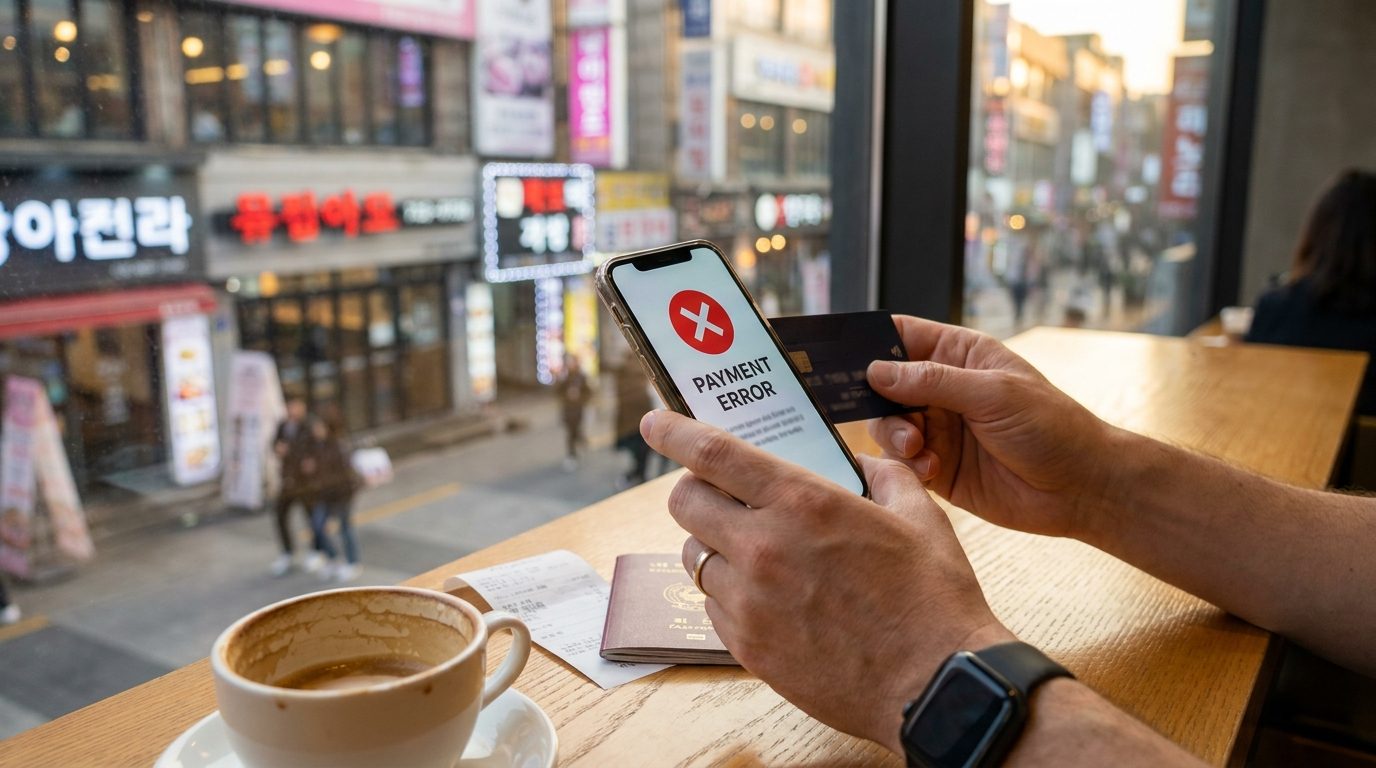
This is why the failure pattern confuses everyone: the app happily accepts your card at registration, then declines it at checkout. Registration only stores the number; checkout runs the verification.
Is it my bank’s fault or Coupang’s?
Both, structurally. Payment-industry analyses (Visa and Stripe have both published on this) consistently find that cross-border online transactions are declined at a far higher rate than domestic ones — your bank sees an unusual cross-border verification request and plays it safe, while Coupang’s payment stack prioritizes the domestic system that the overwhelming majority of its customers use. Neither side is motivated to fix the 1% case — which is cold comfort when you just want water delivered to your hotel.
The 4 fixes that actually exist
1. Try a different card (sometimes works)
Success rates differ by issuing bank more than by network. If you carry two cards, try both. Travelers report slightly better luck with cards that have used international e-commerce recently (the bank already trusts online activity).
2. Use a Korean-network prepaid card (often works)
Tourist prepaid cards like WOWPASS are issued on Korean payment rails — you top up with foreign cash or card, then pay like a local. They work in many Korean apps and stores, though app-by-app support varies. If you’re in Korea for more than a few days, one of these cards solves more problems than just Coupang.
3. Order through a delivery concierge (always works)
This is the workaround that doesn’t depend on any bank’s mood: a local service takes your order in English, you pay by PayPal, and they place the Coupang order for you — delivered to your hotel front desk. It’s what we do at Korea Hotel Delivery: ready-made packs of water, snacks and essentials, or custom orders from any Coupang link (12% service fee, ₩8,000 minimum).
4. Residents: register a Korean card (permanent fix)
If you live in Korea, this problem disappears the day your Korean bank card arrives. Open a bank account with your ARC, link the card in Coupang, and checkout never bothers you again. Until that day, fixes 1–3 apply to you too.
Questions travelers ask
My card was charged but the order failed — was I double-billed? Usually that’s an authorization hold, not a charge. It disappears from your statement within a few business days. If a real charge persists after a failed order, contact your bank with the timestamp.
Does PayPal work directly on Coupang? No — Coupang doesn’t accept PayPal. PayPal enters the picture only through third-party services (like ours) that accept PayPal from you and pay Coupang locally.
Will using a VPN help my card go through? No. The decline happens in the bank-to-payment-gateway verification, not in geolocation. A VPN changes where you appear to browse from, not how your card verifies.
Do Gmarket or other Korean sites accept foreign cards better? Gmarket’s global site (global.gmarket.co.kr) is built for foreign cards and generally clears them — but its delivery is slower than Rocket and the catalog differs. For “I need it at my hotel by tomorrow morning,” concierge ordering remains the dependable route.